
The vanity might be the hardest-working piece of furniture in your house. It gets splashed every morning, leaned on, bumped with hips and opened dozens of times a day. It sits in the most humid room in the home, and it’s usually the first thing you see when you walk into the bathroom.
That’s why it’s worth choosing carefully. A vanity that looks great in a showroom can swell, peel or sag within a few years if it isn’t built for the room. Look at the box, the finish, the top, the sink and the faucet as one piece, then make sure the room around it can actually dry out.
The cabinet box
What the cabinet is made of matters more than how it looks on day one.
- Solid wood is strong and can be refinished, but it moves with humidity. It works best with a good finish and a well-ventilated room.
- Plywood is a common choice for bathroom cabinet boxes. It holds screws well and stands up to occasional moisture better than many particle-based materials.
- MDF takes paint beautifully and is common for painted doors. It’s stable, but raw edges can swell if water gets in, so the finish needs to seal it completely.
- Particleboard is the most budget-friendly and the least forgiving of water. If it gets wet around the sink or the base, it can swell and break down.
Look closely at the sink base. That’s where leaks and drips happen. A durable box there pays for itself.
The finish
A good finish protects the cabinet from water, soap and cleaners. Factory-applied finishes are usually tougher than a quick coat of paint. Ask what finish the cabinet has and how it handles moisture. Look at the edges and the inside of the sink base, not only the door fronts.
Darker painted finishes look striking but can show water spots and dust sooner. Wood finishes and mid-tones tend to hide everyday wear.
The countertop
The top takes most of the daily abuse. Common options include:
- Quartz. Engineered stone that does not need sealing and resists stains well. A popular choice for busy bathrooms.
- Porcelain or sintered stone. Thin, hard and resistant to stains and heat.
- Natural stone. Marble and granite are beautiful, but they vary. Marble in particular can etch from acidic products and usually needs sealing.
- Solid surface. Can include an integrated sink with no seam, and scratches can often be sanded out.
Think about what lives on your counter. Toothpaste, makeup, hair products and cleaners all test a surface. If you want a carefree top, choose one that doesn’t need regular sealing.
The sink
- Undermount sinks sit below the counter, so you can wipe water straight into the bowl.
- Integrated sinks are molded into the top, which removes the seam entirely.
- Vessel sinks sit on top. They make a statement but can splash more and leave a ring around the base to clean.
Bowl depth matters too. A shallow bowl looks sleek but sends more water onto the counter.
The faucet
Choose a faucet with a quality valve, often a ceramic disc cartridge, and a finish that suits how much cleaning you want to do. Matte black and brushed brass are popular and hide fingerprints better than polished finishes, though every finish shows hard-water spots if it is never wiped.
Wall-mounted faucets free up counter space and keep water off the deck, but they need to be planned before the wall is closed up, and the spout has to line up with the bowl.
Storage that fits the way you live
- Drawers beat doors for most people. You can see everything without kneeling down.
- Full-extension, soft-close slides last longer and keep drawers from slamming.
- Plan around the plumbing. A U-shaped drawer or a cutout around the drain keeps storage usable instead of losing the whole sink base.
- Think about outlets. An outlet inside a drawer or cabinet keeps hair tools plugged in and off the counter.
Floating or floor-standing
A floating vanity mounts to the wall and leaves the floor open below. It makes a small bathroom feel larger and makes the floor easier to clean. It also needs solid blocking in the wall to carry the weight of the cabinet, the top and someone leaning on it. That’s something to plan during the remodel, not after.
A floor-standing vanity is simpler to install and can offer more storage. Both can last for years when they’re built well.
Light around the vanity
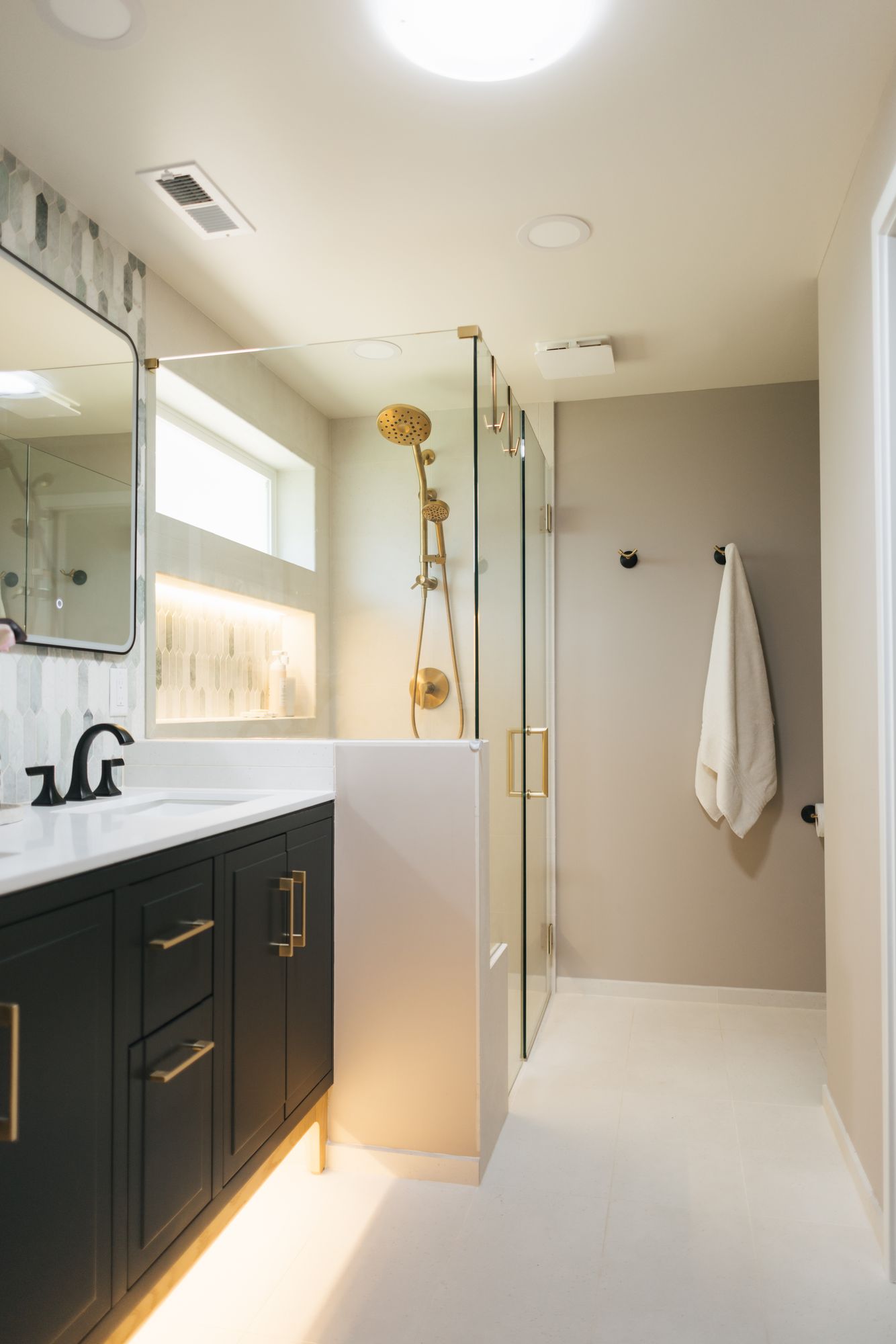
Good lighting makes a vanity easier to use. Backlit mirrors or lights on both sides of the mirror give even light on your face. Toe-kick lighting under a vanity adds a soft night light that helps without waking anyone up.
The room around it
Even the best vanity struggles in a bathroom that stays damp. A properly sized exhaust fan, run during and after showers, protects the cabinet, the finish and the walls around it. It’s one of the least glamorous parts of a bathroom remodel, and one of the most important.
“The vanity is where a bathroom gets used the hardest,” said the Pacific Pro Group team. “We look at the box, the top, the plumbing and the ventilation together, because that is what decides how it looks in ten years.”
A real example: the Ravenna bathrooms
In a whole-house remodel in Ravenna, Seattle, Pacific Pro Group remodeled two bathrooms. In the primary bathroom, a black vanity pairs with matte-black faucets, a white counter and backlit mirrors, against vertical marble-look picket tile. The vanity has toe-kick lighting. A second bathroom in the same house has a lighter oak vanity, a good reminder that a durable vanity can be bold or quiet.
Questions to ask before you buy
- What is the cabinet box made of, especially the sink base?
- Does the countertop need sealing, and how often?
- Will the sink and faucet keep water on the counter or in the bowl?
- Is the storage planned around the plumbing?
- If it floats, is there blocking in the wall?
- Is the bathroom fan sized and ducted to clear the moisture?
A vanity that holds up starts with a moisture-ready box and finish, a top that matches how much care you want to give it, a sink and faucet that keep water where it belongs, and storage planned around the plumbing. Put it in a well-ventilated room. If you’re planning a bathroom remodel, contact Pacific Pro Group for a free quote.